Night Vision by Mariana Allesandri (Dark) Intro-Ch1. RECOMMENDED: A Very Short Introduction to the Meaning of Life by Terry Eagleton (MoL) preface
- Did any of you happen to attend Mariana Allesandri's Lyceum lecture in 2024? (see below*) If so, thoughts? Or any thoughts on the Sidelines account? Or the videos?**
- Do you also feel as though you’ve been raised on “a diet of light” associated with “everything good”? Has that diet been palatable? Do you share Mariana’s temperament and frustration, and her wish to “see in the dark”? Or do you find light an appropriate symbol of enlightenment, reason, and good temper?
- Are you thinking differently about Plato’s cave, after reading Mariana’s version? What does the sun in that allegory mean to you? 4 Or the puppeteers?
- Mariana says she’s angry “genetically” (when she was here she said anger is her “jam”) and “sad most of the time” 5… Can you relate? If so, is that something you want to change about yourself? Or are you comfortable with it, reconciled to it, or aggressively committed to it? More broadly, do you want to be happy? Can a chronically angry and sad person even be happy?
- Are you an Eeyore, a Tigger, a Rabbit, a Pooh, …? Do you recoil from positivity?
- One may resent a sol-centric worldview, but in fact the sun IS (to quote Eric Idle) “the source of all our power” etc. And as we noted the other day, Carl Sagan was right: we ARE “starstuff contemplating the stars... a way for the cosmos to know itself,” products of the cosmic light show. Light IS “our savior,” no? So why isn’t Allesandri’s attraction to the dark side perverse and nihilistic? Why isn’t her attitude “ungrateful” and “self-indulgent”? 7-8 [Let me note: I spent a lot of time with Mariana when she visited. She was pleasant, amiable, delightful, in no way presenting as an Eeyore. So we’re talking mostly about an internal mood, not in most instances a demonstratively uncongenial and anti-social demeanor.]
- Should positively-tempered people just concede that darkness is a (not THE) human condition for some of us? 9 Haven't the existentialists taught us not to make sweeping generalizations about human nature and the human condition? Should they not then make alliance with the pragmatic pluralists who acknowledge a wide variety of legitimate ways of being human?
- Is it stigmatizing to name anxiety an “epidemic” or view it as symptomatic of mental illness or affliction?
- How would you distinguish “toxic positivity” from healthy-mindedness (or healthy-mindedness from reasonable cheerfulness)? 10 If you’re not anxious, does that imply that you’re not “paying attention”?
- Mariana found “love at first sight” with Existentialism. Do you share her characterization of existentialists on p.12?
- Have you read Ehrenreich or Burkeman? 13* If you ever contract a terminal illness, will you resent being told to “chin-up” and “look on the bright side”? How about Wendell Berry? 14 Do you keep a gratitude journal? Or do you ever say to yourself, as the often-sad Kurt Vonnegut did, “if this isn’t nice I don’t know what is?”
- Should women study philosophy, precisely because their numbers are low and their male counterparts so often are jerks? Should anyone ever have to justify their approach to philosophy as “real”? 17
- Is Plato’s “charioteer” unhelpful? Based on Mariana’s intra-familial self-disclosure, does she have an anger-management problem? 21
- Are the Stoics unhelpful, with respect to managing anger? Or Aristotle? Or the “view from above”? Or Mr. Rogers? 22f. What do you think of “Broicism”? 26
- Was Lorde right about anger, progress, and change? 29
- Can repressed anger manifest in physical symptoms? 32
- What would have happened to the Jan. 6 rioters if they’d been Black, or immigrants? 34
- Would you add anything to the taxonomy of the varieties of anger? 37
- Have you ever suffered epistemic injustice? How’d you respond? 43
- [MoL] When he was here, John Kaag agreed with my characterization of Terry Eagleton as "clever" (not necessarily in a good way). What do you think?
- Regarding the dedication to "Oliver": Why would the question of life's meaning be "embarrassing"?
- What do you think of the story of Bertrand Russell and the taxi driver? Why shouldn't philosophers be expected to have something to say concerning "what it's all about"? 28
- Is the question of meaning, or of Being, just a ponderous way of saying 'Wow!'? If it's a valid question for poets and mystics, why not for (non-poet/mystic) philosophers? 3
- If we knew the meaning of life, would life then be devoid of meaning? 9 Would we cease to "meditate on our being in the world"? 13 Do those who seek meaning already possess it? 29
- Are Americans still "chronically up-beat," compared at least to Brits? 11
- Have religion, culture, and sexuality really become "less central to public life"? 20
- What are "chiropractors of the psyche"? 24 Why is the quest to find oneself "tiresome"?
- Is sport (or gambling on it) "now the opium of the people"? 26
- Eagleton can't remember Monty Python's meaning. Check the sidebar, it's there. What do you think?
*MTSU Philosophy Department hosts annual Lyceum lecture series with Mariana Alessandri
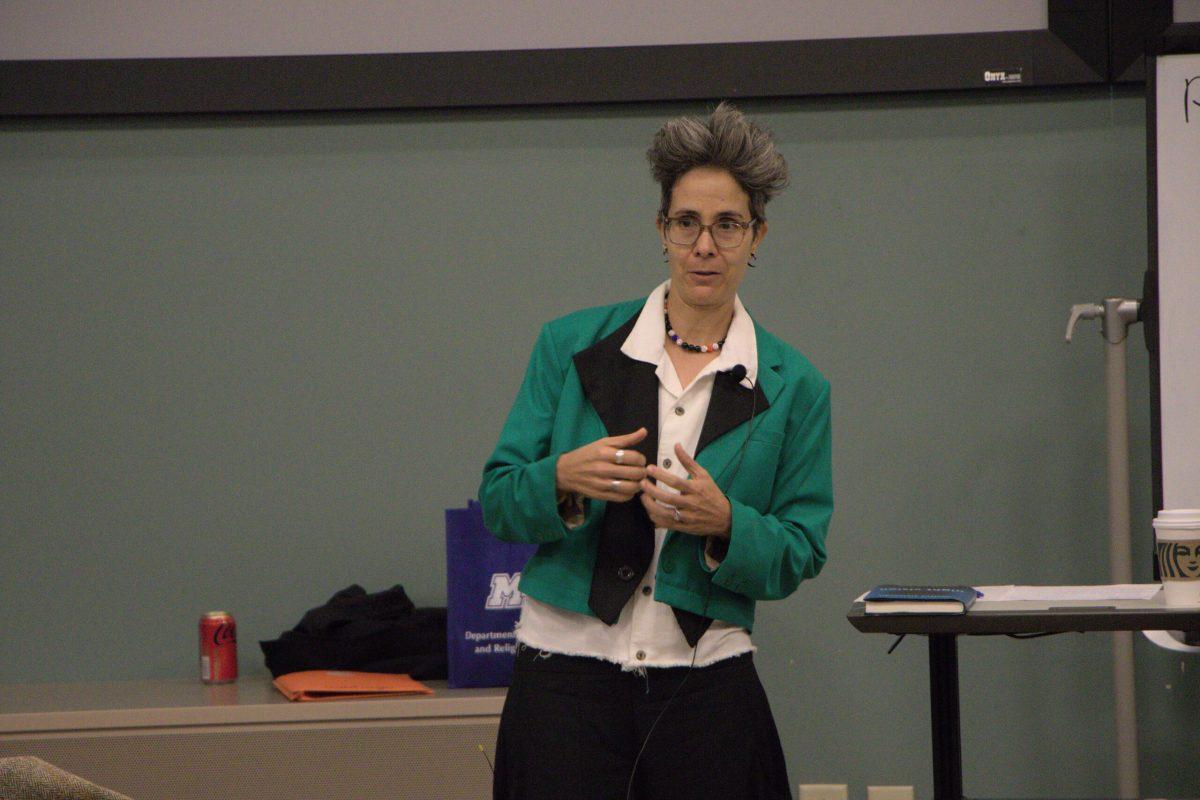
The MTSU Philosophy Department held their annual Applied Philosophy Lyceum lecture series
The Department of Philosophy and Religious Studies hosted Mariana Alessandri Friday at its annual lecture series lyceum, “The Upside of Anxiety: Kierkegaard on Feeling Better About Feeling Bad.”
Since 1992, the Philosophy Department held a lecture series devoted to lectures on Applied Philosophy. Lyceum pays tribute to Aristotle’s school of philosophy, founded in 334 B.C. The department intends to bring philosophical insight to all students interested in the concepts. They achieve this by stimulating private reflection and the human practice of thinking broadly on an array of applied philosophical topics.
“We’re thrilled with the variety of speakers and topics we’ve been able to sponsor,” said Mary Magada-Ward, the philosophy department chair. “Students come out just to hear the topics. Topics covered in this lecture have ranged from topics of love and relationship to environmental ethics.”
This year, the Department of Philosophy and Religious Studies hosted Alessandri, an author and associate Professor in the Philosophy Department at the University of Texas Rio Grande Valley. Motivated by educating others on feeling better about their bad feelings, Alessandri came to MTSU to share her perspective on “anxiety,” a mental illness 1-of-3 college students battle.
In the lecture, she discussed redeeming humans from always feeling broken due to dark moods of anxiety, anger, depression and sadness. She mentioned shame and feeling bad for having anxiety or depression.
Alessandri aimed to encourage others to look at society in the dark, from a dimmer light, to actually see it for what it is. She felt that when people look at anxiety from a light–everyone is supposed to be happy all the time–perspective, it makes the world look terrible.
She suggested the concept of existentialism. Alessandri said the human condition is holding hands through rough moments and human suffering, not shaming oneself and others for having moods and feeling emotions.
Phil Oliver, Associate Professor of the Department of Philosophy and Religious Studies, like other department officials, feels the lecture helped students understand sadness.
“This helped students think they’re not broken because they have anxiety, that it’s human, and if you can see that you’re not broken, you can learn from being anxious and being human,” said Oliver.
In addition to her perspective, Alessandri drew from her book, “Night Vision: Seeing Ourselves Through the Dark Moods,” and used the findings of philosopher Seren Kierkegaard to defend her perspective. In her book, she cited philosophers in every chapter and countered it with existentialist philosophers to help her see the mood in the dark.
Alessandri said she was inspired to write this book after struggling to stay positive and wanting to live, to help others live. After an abundance of demands her peers had for hearing her speak about this unusual topic, she decided to lecture on it at MTSU to college students.
Her interest in philosophy grew from finding others in the field who were willing to think the way she did without ridiculing her.
“It felt welcome to be able to think deeply,” said Alessandri.
She said she liked talking to others about dark moods because it felt emotionally honest, and gave advice to everyone who battles anxiety and other dark moods.
“We’re not broken, just human,” said Alessandri.
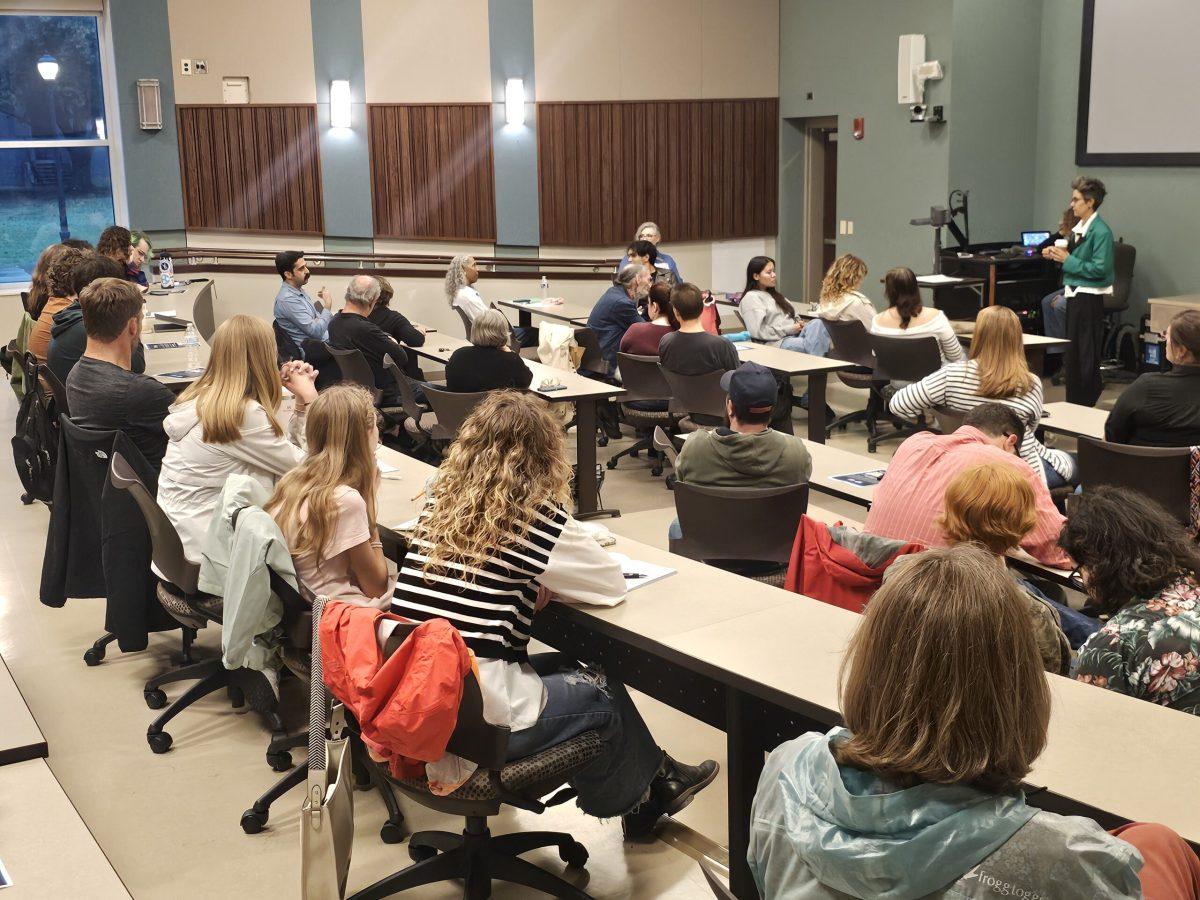
Teachers and students engaged in deep questioning of the philosopher’s perspectives and concepts. The audience generally enjoyed the lyceum and discussion.
“In the most profound sense, the absurdist in me is happy to learn about a speaker in philosophy who embraces the thought of Kierkegaard,” said Sneh Gandhi, a junior philosophy and English major.
The lyceum audience included philosophy students, professors, the College of Liberal Arts Dean Leah Lyons and Magada-Ward, eager to hear Alessandri’s perspective. Lyons was especially delighted with the event turnout.
“The Philosophy Lyceum offered our campus the opportunity to see a common issue in our society–anxiety–through a clearer lens, a lens that invites us to think more deeply about the human condition,” said Lyons. “This is at the heart of a Humanities education–thinking critically about our world and our place in it, so I am pleased that our Department of Philosophy and Religious Studies invited Dr. Alessandri to our campus. I am equally pleased that this Philosophy Lyceum was so well-attended.”
**


No comments:
Post a Comment