Monday, August 31, 2026

Talk, talk, talk! Words, words, words...

[Substack]

We were talking (talking, nota bene) the other day about the limits of language, and William James's sense of the "glimmer and twinkle" of something in "the living act of perception," something that language cannot catch but that honest philosophers must acknowledge. I'll be curious to see if the Existentialists share a similar skepticism towards those who uncritically accept our human ability to know reality verbally. The post-existentialist structuralists, post-structuralists, deconstructionists, theoretical psychoanalysts, Derrideans et al definitely do not. (Or maybe it would be better to say they don't really buy into the idea that "reality" names something nonverbal.) Derrida famously said “Il n’y a pas de hors-texte” ("there is no outside-the-text"), a view James would find laughable. Me too.

I was reminded of this while reading Emily Eakin's new memoir/history of those post-existentialists, The Frenchmen. At the end of chapter 27 she writes of Jacques Lacan (1901-1981):

...he'd scrubbed his work of any residue of biology or Darwin... there were fewer and fewer allusions to the world of things. Lacan had abandoned Earth for the theoretical firmament. [A critic wrote:] '...when I read his work I can't help thinking, 'Words, words, words.'

And at the beginning of chapter 28:

Words, words, words indeed. You'd be hard pressed to come up with a better slogan for the decade [of the fifties in French philosophy]. 

Ha! In 1892 William James had written:

What an awful trade that of professor is—paid to talk, talk, talk! I have seen artists growing pale and sick whilst I talked to them without being able to stop. And I loved them for not being able to love me any better. It would be an awful universe if everything could be converted into words, words, words. --Letters I, Dec 28

And in Pragmatism III (1907) be wrote:

The really vital question for us all is, What is this world going to be? What is life eventually to make of itself? The centre of gravity of philosophy must therefore alter its place. The earth of things, long thrown into shadow by the glories of the upper ether, must resume its rights. To shift the emphasis in this way means that philosophic questions will fall to be treated by minds of a less abstractionist type than heretofore, minds more scientific and individualistic in their tone yet not irreligious either. It will be an alteration in 'the seat of authority' that reminds one almost of the protestant reformation.

James loved words too. He just didn't think they crowd out nature and the rest of the unverbalized fields of our experience. As Shakespeare's Prince Hamlet said: “There are more things in heaven and earth, Horatio, than are dreamt of in your philosophy.” So WJ would say to Lacan and his logorrheic peers.

Think for yourselves, American scholars (but not BY yourselves)

On this day in 1837, Ralph Waldo Emerson delivered his famous “American Scholar” address to the Phi Beta Kappa Society at Harvard. He told the students to think for themselves rather than absorb thought, to create rather than repeat, and not to look to Europe for cultural models...

https://www.garrisonkeillor.com/radio-categories/twa-2018/

Thursday, August 27, 2026

Questions Sep 1

Again, try to post at least three questions and/or comments, PRIOR to class, pertaining to today's reading. Try formulating discussion-oriented, open-ended questions related to these mostly-factual questions about the contents of our text.

Ex'm ch1-2

  1. Existentialism's deepest roots are in an ancient Greek practice called ___, with a focus on what kinds of questions and attitudes? What became of that practice, in the subsequent history of philosophy?
  2. What did Kierkegaard and Nietzsche both respect about Socrates? What view of truth did Kierkegaard think Socrates exemplified? Do you think Socrates would have endorsed Kierkegaard's account? [NOTE:This last question is discussion-oriented, in contrast to the other text-oriented questions which have a definitive answer in the text. Discussion-oriented questions are more open-ended.]
  3. What is ethical emotivism?
  4. What notion of space is illustrated by the tendency of students to self-assign their seating arrangements in class?
  5. Which (if any) of the five basic themes of Existentialism most resonates with you personally? Why?
  6. What have some misunderstood about Kierkegaard's "truth as subjectivity"? 
  7. What did pragmatist William James say about "our passional nature" that echoes Kierkegaard's view of "conversion experience" and "leaps of faith"?
  8. Why, for the existentialists, is "my truth" not a self-contradictory oxymoron? 
  9. What was Sartre's general thesis about the stance literature and art should take towardes social oppression and economic exploitation?
  10. Who are some prominent literary figures who exemplify existentialism?
  11. What is intentionality?
  12. What was Descartes' Pyrrhic victory?
  13. What is the point of Sartre's discussion of the voyeur at the keyhole?
  14. What do existentialists find objectionable in Husserl's phenomenological reduction?
  15. What are some different names existentialists have come up with to characterize conformists?
  16.  By what criteria was Kierkegaard the epitome of a Nietzschean?
  17. What are Kierkegaard's three spheres or stages of existence?
  18. What are some ethical categories that apply only after a leap or conversion experience, for Kierkegaard? Do you agree that people who live entirely in the aesthetic sphere are not immoral?
  19. What Kantian precept is for Kierkegaard the essence of immorality? 
  20. Do you agree that Kierkegaard's "teleological suspension of the ethical" is not its practical abandonment? How do you think such behavior as Abraham's would impact his relationship with his son Isaac?
  21. Is it plausible to deny free will and at the same time affirm individual freedom and "free spirits," in Nietzschean style? Is it an existential error to emphasize the importance of choice in fashioning a free and flourishing life?
  22. Was Nietzsche right to think that atheism naturally entails nihilism, in the absence of a philosophy like his own?
  23. If fatalism is correct, how can Nietzsche's eternal recurrence afford the possibility of life affirmation and amor fati? How can one choose to affirm life, when events are fated? And how can thought-events be non-arbitrarily exempted from such fatalism?
  24. What general 20th century calamity did Jaspers credit Nietzsche and Kierkegaard with anticipating? Do you think we're still suffering a version of that calamity, in the face of our own emergent technologies?

Wednesday, August 26, 2026

Questions Aug 27

Always try to post at least three pertinent comments and/or questions about the assigned reading PRIOR to each class, in the comments space below my questions. I'll show you in class how to claim participation credit on the daily scorecard for doing so. 

Your comments and questions can (but need not) respond to my dated questions, which will provide the content of our exams. 

Not many questions today, we'll take some time before discussing them for you to introduce yourselves.


Existentialism: A Very Short Introduction by T. Flynn (Ex'm) preface

  1. The predominant mood of mid-20th century Parisian existentialists was always what? How did they prefer to do philosophy? In what mood do you find yourself, when philosophizing? Do you share their preference? 
  2. What was Nietzsche's advice? Are "existential individuals" born, or made (achieved)? Do you think of your life as a potential succession of "stages," as Kierkegaard did? If so, how would you label/describe your present stage?
  3. What post-war essay by Sartre rocked Paris? If you've read it, what do you (dis)like about it? With what kind of philosophy was Existentialism then linked? How do you respond to this question?
  4. The supreme value and virtue of Existentialism are what? How do you define these terms? How do you attempt to realize them in your life?
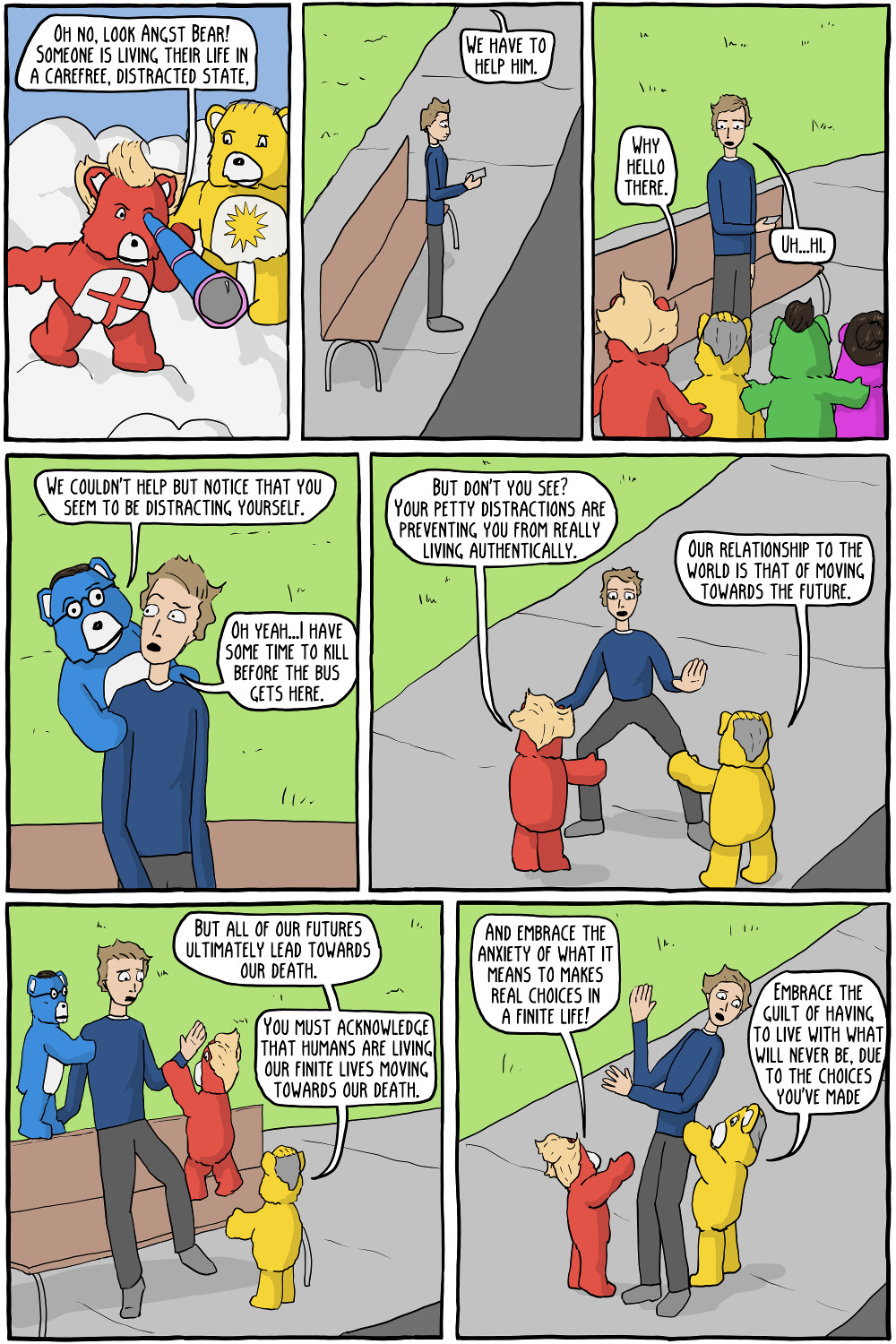
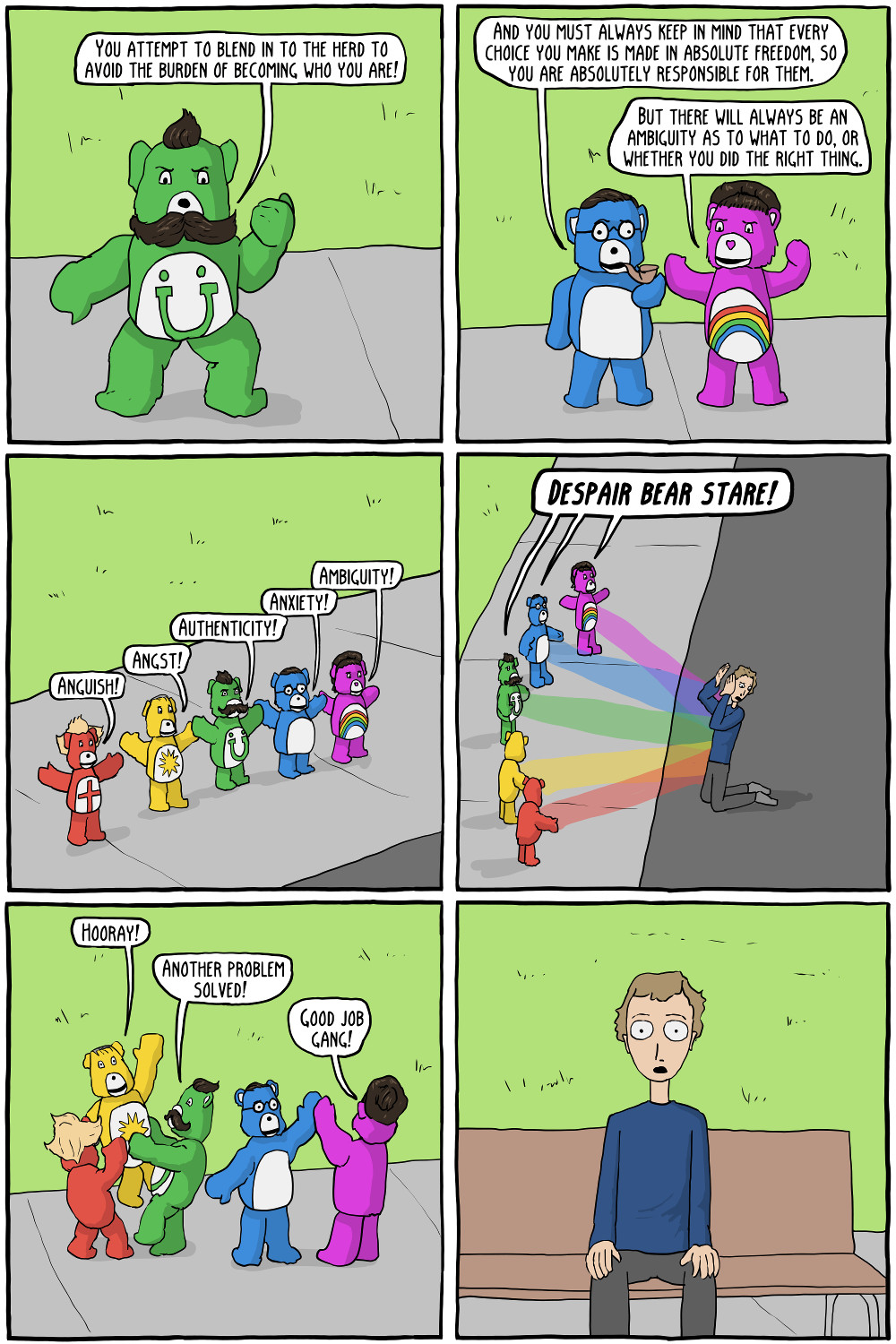
  5. Any comment on any of these Existential comics?

European Intellectual History Since Nietzsche: a Yale history course

If any of you know of other relevant online courses or podcasts you think might be appreciated by some of us, please share in the comments space below. 


“In general modern man has no solutions.”—Alexander Herzen, From the Other Shore. 

HIST 271/HUMS 339: European Intellectual History since Nietzsche is a survey course designed to introduce students to the dominant trends in modern European intellectual history. The class aims to sketch a narrative arc from the late 18th century transition to modernity through the late 20th century transition to post-modernity. Following an overview of the Enlightenment and Romanticism, we move through Hegelianism and Marxism and then on to Nietzsche’s declaration of the death of God. (God had been multifunctional, fulfilling epistemological, ontological and ethical roles. His death left an enormous empty space. Much of modern thought could be described as an attempt to replace God.) Topics include Marxism-Leninism, psychoanalysis, expressionism, structuralism, phenomenology, existentialism, anti-politics, and deconstruction. Authors include Nietzsche, Lenin, Kafka, Freud, Husserl, de Beauvoir, Heidegger, Arendt, Adorno, Sartre, Girard, Foucault, Derrida and Havel. With Marci Shore, Associate Professor of History at Yale. To view and/or download a course syllabus and class handouts, please go to this link. https://yaleedu.sharepoint.com/:f:/s/... To view the entire course, please go to this playlist link.    • European Intellectual History since Nietzsche  

Episode 13: The French Existentialists... Episode 16: The Second Sex

Ask

Get answers, explore topics, and more
Other Yale courses: https://www.youtube.com/@YaleCourses
==
If you know of other relevant online courses or podcasts you think might be beneficial to some of us, please tell us in the comments space below. 

Kierkegaard - Ether/Or


This lecture discusses Kierkegaard’s reaction to Hegel, link to Kant, and the emphasis on the choice between the aesthetic and ethical domains of existence. 


Monday, August 24, 2026

Introductions

Let’s introduce ourselves, Existentialism class of ‘26/'30. Go to the comments space below and tell us who you are, why you’re here, how you’d summarize your personal philosophy of "life, the universe, and everything" (but be less concise than "42"), what y'30our existence means to you, & anything else you’d care to share.* 

Who am I, why am I here? A recent interview: https://american-philosophy.org/i-am-an-american-philosopher-interview-series/i-am-an-american-philosopher-phil-oliver/

==

I consider myself a philosopher in the peripatetic tradition, at least in the ambulatory sense: Like teachers and students at Aristotle's Lyceum, I prefer the outdoors and generally would rather roam than sit (at least on the nicer days). I agree with Kierkegaard, who said he'd walked himself into his best thoughts; and Nietzsche, who said the best thoughts are conceived while walking; and Emerson, who said walking is a gymnasium of the mind. So I look forward to getting out of our classroom and onto the grounds of our Lyceum at MTSU, when the weather allows.

This is me, with Nell and Pita (who we brought home with us from the humane shelter in 2018):


==

This is my first time teaching this course, I had to wait for Dr. Principe to retire before I got my shot (just in time before my own looming retirement, so there's one more thing off the bucket list). I've wanted to teach an Existentialism course ever since I took one back in the day at my undergrad alma mater Mizzou (U of Mo) from the late Joe Bien, who used to chain-smoke unfiltered Pall Malls in class and who'd learned a way of pronouncing "Sartre" at the Sorbonne that I can't replicate... so I just pronounce it "Sart"... We thought he looked a lot like Clark Kent (aka Superman).


I was also intrigued, as an undergrad, by the mysterious and intense Alexander von Schoenborn's courses on Husserl and Heidegger (also by his cryptic remark to me that I wrote like T.S. Eliot, he of The Waste Land and Prufrock... who do you think he looks like?). Herr Doktor Professor von S didn't tell us then, if he knew, about Heidegger's Nazi affiliation. That's something any student of Ex'sm needs to come to terms with. Seems to me the biography of any philosopher is always relevant.
==
*A course on Existentialism is inevitably also a course on Meaning (as in "meaning of life"). I taught a course at Vanderbilt once called The Meaning of Life. I can't easily summarize its total message, but part of the MoL for me is captured by the words at John Dewey's final abode:

Dewey’s epitaph, on the UVM campus in Burlington, Vermont:

John Dewey
Philosopher
Educator
Class of '79

“The things in civilization we most prize are not of ourselves. They exist by grace of the doings and sufferings of the continuous human community in which we are a link. Ours is the responsibility of conserving, transmitting, rectifying and expanding the heritage of values we have received, that those who come after us may receive it more solid and secure, more widely accessible and more generously shared than we have received it.”

A Common Faith, conclusion
==
P.S., FYI- I've made a couple of audio recordings, going over some of the current content of this site... Ex'sm 1... Ex'sm2

Sunday, August 23, 2026

The Existential Crisis Iceberg

 This video serves as an excellent introductory primer for an existentialism course because it bridges the gap between pop-culture philosophy and academic concepts. It takes abstract theories and maps them onto an existential crisis iceberg format.


Saturday, August 22, 2026

What Makes a Life Significant, by William James

 The solid meaning of life is always the same eternal thing, — the marriage, namely, of some unhabitual ideal, however special, with some fidelity, courage, and endurance; with some man's or woman's pains. — And, whatever or wherever life may be, there will always be the chance for that marriage to take place…

https://monadnock.net/james/life.html

A Significant Life

A Significant Life: Human Meaning in a Silent Universe by Todd May

What makes for a good life, or a beautiful one, or, perhaps most important, a meaningful one? Throughout history most of us have looked to our faith, our relationships, or our deeds for the answer. But in A Significant Life , philosopher Todd May offers an exhilarating new way of thinking about these questions, one deeply attuned to life as a work in progress, a journey—and often a narrative. Offering moving accounts of his own life and memories alongside rich engagements with philosophers from Aristotle to Heidegger, he shows us where to find the significance of our lives in the way we live them. 

May starts by looking at the fundamental fact that life unfolds over time, and as it does so, it begins to develop certain qualities, certain themes. Our lives can be marked by intensity, curiosity, perseverance, or many other qualities that become guiding narrative values. These values lend meanings to our lives that are distinct from—but also interact with—the universal values we are taught to cultivate, such as goodness or happiness. Offering a fascinating examination of a broad range of figures—from music icon Jimi Hendrix to civil rights leader Fannie Lou Hamer, from cyclist Lance Armstrong to The Portrait of a Lady ’s Ralph Touchett to Claus von Stauffenberg, a German officer who tried to assassinate Hitler—May shows that narrative values offer a rich variety of criteria by which to assess a life, specific to each of us and yet widely available. They offer us a way of reading ourselves, who we are, and who we might like to be.  

Clearly and eloquently written, A Significant Life is a recognition and a comfort, a celebration of the deeply human narrative impulse by which we make—even if we don’t realize it—meaning for ourselves. It offers a refreshing way to think of an age-old question, of quite simply, what makes a life worth living. 

https://www.goodreads.com/book/show/22859686-a-significant-life

The point of life

He Said He Was the World’s Healthiest Man. Then Came a Stunning Diagnosis.

 Trying to defeat aging, Dr. Emanuel and other critics of the live-forever movement say, is arrogant and narcissistic.

Dr. Emanuel supports simple — even enjoyable — biohacks like cutting out ultraprocessed foods, getting good sleep and taking up new experiences. The title of his latest book, “Eat Your Ice Cream,” speaks for itself.

“The point of life, I think, is to make the world better for your family, your community, for humanity,” Dr. Emanuel said. “We’re here for a short time, and it’s not all about us.”
https://www.nytimes.com/2026/08/21/us/bryan-johnson-biohacker-autoimmune-gastritis.html?smid=nytcore-ios-share

Friday, August 21, 2026

Applied Philosophy Lyceum: Oct 2, 5 pm, COE 164

The Digital Cave

Reading, Thinking, and Dwelling in the Age of the Algorithm

An Applied Philosophy Talk by John Kaag

Abstract

We live in an era of industrial-scale shadow-play. The map of reality is no longer drawn from our own experience but projected by algorithms designed to keep us looking at a particular kind of wall. This talk argues that the oldest resources in the philosophical canon offer the most precise diagnosis of our newest predicament. Plato's cave anticipates the architecture of the feed—with one grim perversion: his prisoners at least shared a wall, while the algorithm builds a bespoke cavern for each of us. The Buddhist vocabulary of maya, tanha, and upadana describes with uncanny accuracy the mechanics of craving, clinging, and curated selfhood that the infinite scroll exploits. And Heidegger's account of Enframing—read alongside his catastrophic biography, which cannot be waved away—explains how attention itself became “standing reserve,” a resource to be extracted.

The talk concludes with the question increasingly posed to our machines: why is talking to a large language model so strange? The answer reveals a schism between information and meaning, between the calculative synthesis at which AI excels and the meditative, embodied, abductive thinking that a life—with something at stake—alone makes possible. Philosophy's task has not changed since the cave: to make us suspicious of the reality that appears most obvious, and to recover the gritty practices that might let us turn our heads, a few degrees, toward the light.

About the Speaker

John Kaag is Professor of Philosophy at the University of Massachusetts Lowell, External Professor at the Santa Fe Institute, and Visiting Professor at Harvard Divinity School. He is the author of three widely acclaimed books published by Farrar, Straus and Giroux: American Philosophy: A Love StoryHiking with Nietzsche: On Becoming Who You Are, and Sick Souls, Healthy Minds: How William James Can Save Your Life. These books were named NPR Best Books of the Year and New York Times Editors' Choice selections.

His work bridges American pragmatism, intellectual history, ethics, and the philosophy of technology, and he writes regularly for general audiences on why philosophy still matters for everyday life.

Wednesday, August 19, 2026

Kierkegaard and the Untruth of The Crowd

This video takes a deep dive into Søren Kierkegaard’s essay, "The Crowd is Untruth," where he argues that real, honest truth is something you can only find on your own, rather than getting lost in a group. Dr. Gregory Sadler breaks down why relying on a crowd can actually strip away your personal accountability, making it easier to ignore what’s right. He closes by explaining how you can take back your power and start owning your choices by simply choosing to step out from the crowd's shadow.


Monday, August 17, 2026

"Hell is other people"

We all know hellish people, or people we'd like to send there (or at least threaten to, if there was a there there).


But Sartre's point was that it's damnably de-humanizing to be objectified by people who will not acknowledge your subjectivity-the core of your humanity. This is not the misanthropic statement it's often mistaken to be. It's a call to recognize the inner lives and the human Being in others that true misanthropes disregard. "Sartre argues that consciousness is radically free , never fixed, always choosing itself. Other people threaten that freedom through what he called the look: their gaze objectifies, turning you into something static and defined. In No Exit, three characters cannot escape each other’s looks after death, and that permanent objectification is the hell he had in mind."

William James said it better, and said it first:

...Now the blindness in human beings, of which this discourse will treat, is the blindness with which we all are afflicted in regard to the feelings of creatures and people different from ourselves. We are practical beings, each of us with limited functions and duties to perform. Each is bound to feel intensely the importance of his own duties and the significance of the situations that call these forth. But this feeling is in each of us a vital secret, for sympathy with which we vainly look to others. The others are too much absorbed in their own vital secrets to take an interest in ours. Hence the stupidity and injustice of our opinions, so far as they deal with the significance of alien lives. Hence the falsity of our judgments, so far as they presume to decide in an absolute way on the value of other persons' conditions or ideals.
Take our dogs and ourselves, connected as we are by a tie more intimate than most ties in this world; and yet, outside of that tie of friendly fondness, how insensible, each of us, to all that makes life significant for the other!--we to the rapture of bones under hedges, or smells of trees and lamp-posts, they to the delights of literature and art. As you sit reading the most moving romance you ever fell upon, what sort of a judge is your fox-terrier of your behavior? With all his good will toward you, the nature of your conduct is absolutely excluded from his comprehension. To sit there like a senseless statue, when you might be taking him to walk and throwing sticks for him to catch! What queer disease is this that comes over you every day, of holding things and staring at them like that for hours together, paralyzed of motion and vacant of all conscious life?
...
On a Certain Blindness in Human Beings (1899)


Thursday, August 13, 2026

Hannah Arendt’s American Education

 with Heidegger’s tender encouragement—had his wife become suspicious?—Arendt left Marburg for Heidelberg, where she wrote a dissertation on St. Augustine under Karl Jaspers. She continued meeting Heidegger during trips he made for another two years.

After completing her dissertation, she married a man she had met in one of Heidegger’s seminars in Marburg, Günther Stern, later known as Günther Anders. Her life had moved on, but her estimate of Heidegger had not: she never denied his intellectual power. In 1933, however, when Heidegger became rector of the University of Freiburg, he delivered a preposterous speech celebrating the new regime. Arendt was appalled by his embrace of the Hitler movement. When she later recalled the Nazi seizure of power, she said that the behavior of ordinary Germans had surprised her less than the “fantastische” ideas with which intellectuals greeted Hitler. Heidegger, the philosopher of authenticity and independent thought, had become one of them, surrendering to vicious political cant...

https://www.newyorker.com/magazine/2026/08/17/hannah-arendt-life-of-the-mind-thomas-meyer-book-review-an-admirable-woman-arthur-cohen

Wednesday, August 12, 2026

We're losing the point of college

Even Elite Colleges Have Become Trade Schools
Short-term return on investment is an impoverished view of a college education.

... it feels that, as a country, we’re “losing the point” of college, which in his mind, was supposed to be about figuring “out who you are and what you’re interested in.” His experience was that “people need to know what they want to do after college when they get to college,” which is a tall order for a teenager.

...a poignant anxiety I hear when I speak to college students: They have started worrying about employability the second they walk through the campus gates, if not before. While President Trump has pitted the idea of higher education against trade schools, as if the two types of institutions have different aims, that distinction is largely antiquated.

As the new school year begins, it’s worth pointing out how students and administrators treat colleges — even elite universities — as a catapult to a “good job” above all else.

Which is to say: Colleges are already trade schools.

The top two majors for students at four-year institutions as of 2022 are business and health professions. In June, the Department of Education issued its “earnings accountability” rule, which states that undergraduate programs have to show that their students earn more than a person with a high school diploma, and graduate programs have to show that their students earn more than a person with a college diploma, or they risk losing access to federal loans.

Nathan Heller, in a 2023 New Yorker article about the death of the liberal arts major, offered a history of the competing aims of the American university. In the 1960s, our institutions of higher ed were described by Clark Kerr, president of the University of California system, as a multiversity that “incorporates the tradition of land-grant universities, established with an eye to industrial-age skill sets. And it provides something for everyone.” The pursuit of knowledge and beauty, scientific research, and pre-professional studies were all bound together, even if it was never a harmonious union.

That fractious union was breaking apart long before the second Trump administration took a wrecking ball to the federal funding of research across disciplines. But the effort to put higher education in its place started much earlier. Over the past 30 years, there has been a concerted effort by mostly conservative politicians to diminish trust in the value of college, and to provide less federal funding for it. They paint America’s colleges and universities as foolish, progressive hotbeds of ethnic studies departments where impressionable young people get expensive Marxist indoctrination rather than marketable, useful skills.

It wasn’t always like this. There used to be bipartisan agreement that our universities were a source of civic strength, and local leaders wanted to keep educated young people from leaving their states. The political scientists Eric Schickler and Elina Maria Rodriguez analyzed a data set of over 1,000 state and national party platforms from 1980 to 2025 to show how Republicans have turned against higher education. In the ’80s and ’90s, some state-level Republicans supported public universities with high praise and high funding, Schickler and Rodriguez explain in an article published this year in the journal Studies in American Political Development.

...When we reduce college to metrics like short-term return on investment, we are ignoring so much human potential it is staggering: Young people who don’t have the resources to pay out of pocket for their college degrees are going to be pushed into jobs that they might be ill suited for, rather than getting to explore their intellectual potential in fields that are not immediately remunerative.

Who knows how many kids we have already trapped in a cutthroat competition to get a small number of finance or tech jobs, when their brains might have been put to better use creating the next great piece of literature, designing a new kind of green building, or working in a lab that could lead to the next medical breakthrough? When we impugn the more esoteric ambitions of higher education, we lose the ability to dream big about what our young people can accomplish...

https://www.nytimes.com/2026/08/12/opinion/elite-college-trade-school.html?smid=em-share

Are you using AI? Do Not Forget Your Whip (to create a healthy distance)

"...Next time you find yourself mindlessly on a screen, create distance. Find pure air and solitude. Stare at a tree, watch a cat, touch a leaf, smell all the smells, even the bad ones. Talk to someone who might disagree with you, such as a teenager. Be someone’s best enemy, and let them be yours. These small distances are acts of defiance against an escalatingly automatic world. It’s not too late to cherish humanity in all its mysteriousness, beauty, and ugliness, and always worth the effort."
Skye Cleary

https://skyecleary.substack.com/p/are-you-using-ai-do-not-forget-your?r=35ogp&utm_campaign=post-expanded-share&utm_medium=web

Starved for meaning

Arthur Brooks (now at Vanderbilt) says we are starving our right brains of love, meaning, mystery, purpose, and (thus) our whole selves of happiness… https://youtu.be/rSJQf72jlGA?is=rylTWtsfMI0oNQnx

Sunday, August 9, 2026

Writing is thinking

Converse with A.I., but write and think for yourself.

“…What, uniquely, does writing do? It compels thought. It compels thinking in ways that silent contemplation or spoken language rarely can. It compels us to subject our thinking to the effort of articulation, the rigor of grammar, the tests of intelligibility and coherence, the inspection of others. In doing so, it also enjoins us to be clear, logical, accurate — and accountable. People may easily forgive a word said in anger but not so easily one written in anger, precisely because the fact that it was written tells us that it was considered...”

https://www.nytimes.com/2026/08/04/opinion/artificial-intelligence-ai-writing.html?smid=nytcore-ios-share

The Nothing nothings

Same, for some existentialists (for pragmatists, not so much):

Uploaded Image


(Martin Heidegger famously wrote and stated "the nothing nothings" (das Nichts nichtet) in his inaugural lecture titled "What Is Metaphysics?" (Was ist Metaphysik?), delivered at the University of Freiburg on July 24, 1929. )

Saturday, August 8, 2026

Right of refusal

"When you refuse the role they give you, you are not doing nothing—you are proving that your life is yours to choose, not theirs to assign." — Jean-Paul Sartre

Nietzsche's Eternal Recurrence

From When Nietzsche Wept by Irvin Yalom-
In 19th-century Vienna, a drama of love, fate, and will is played out amid the intellectual ferment that defined the era.

Josef Breuer, one of the founding fathers of psychoanalysis, is at the height of his career. Friedrich Nietzsche, Europe's greatest philosopher, is on the brink of suicidal despair, unable to find a cure for the headaches and other ailments that plague him. When he agrees to treat Nietzsche with his experimental "talking cure", Breuer never expects that he, too, will find solace in their sessions. Only through facing his own inner demons can the gifted healer begin to help his patient.

In When Nietzsche Wept, Irvin Yalom blends fact and fiction, atmosphere and suspense to unfold an unforgettable story about the redemptive power of friendship. g'r


You can find the whole film on YouTube.

vvvvvv
“Live when you live! Death loses its terror if one dies when one has consummated one's life! If one does not live in the right time, then one can never die at the right time.”

“To build children you must first be built yourself. Otherwise, you’ll seek children out of animal needs, or loneliness, or to patch the holes in yourself. Your task as a parent is to produce not another self, another Josef, but something higher. It’s to produce a creator.”

“eternal recurrence means that every time you choose an action you must be willing to choose it for all eternity. And it is the same for every action not made, every stillborn thought, every choice avoided. And all unlived life will remain bulging inside you, unlived through all eternity. And the unheeded voice of your conscience will cry out to you forever.”
^^^^^^

341.

The Heaviest Burden.—What if a demon crept after thee into thy loneliest loneliness some day or night, and said to thee: "This life, as thou livest it at present, and hast lived it, thou must live it once more, and also innumerable times; and there will be nothing new in it, but every pain and every joy and every thought and every sigh, and all the unspeakably small and great in thy life must come to thee again, and all in the same series and sequence—and similarly[Pg 271] this spider and this moonlight among the trees, and similarly this moment, and I myself. The eternal sand-glass of existence will ever be turned once more, and thou with it, thou speck of dust!"—Wouldst thou not throw thyself down and gnash thy teeth, and curse the demon that so spake? Or hast thou once experienced a tremendous moment in which thou wouldst answer him: "Thou art a God, and never did I hear anything so divine!" If that thought acquired power over thee as thou art, it would transform thee, and perhaps crush thee; the question with regard to all and everything: "Dost thou want this once more, and also for innumerable times?" would lie as the heaviest burden upon thy activity! Or, how wouldst thou have to become favourably inclined to thyself and to life, so as to long for nothing more ardently than for this last eternal sanctioning and sealing?

The Gay Science (La Gaya Scienza), OR The Joyful Wisdom 1882

==

[Eternal recurrence] crops up in Thus Spoke Zarathustra (1883-5), for example, where Zarathustra repeats seven times this incantation: “Oh, how should I not lust for eternity and for the wedding ring of rings – the Ring of Recurrence! Never yet did I find the woman by whom I wanted children, unless it be this woman, whom I love: for I love you, O Eternity! For I love you, O Eternity!” However, the idea is not fully examined or explored there: instead one is supposed to ponder its implications for oneself.

The fullest treatment of eternal recurrence appears in The Joyous [Gay] Science (1882)...

https://philosophynow.org/issues/137/Eternal_Recurrence_Revisited

An existential run in Amsterdam

"Over matcha at breakfast, I was thinking how (at the risk of making everything existential…) everything on my mini tour was intimately connected to freedom, i.e. what you do with your freedom and the cost of exercising it…" Skye Cleary


Thursday, August 6, 2026

Syllabus 2026

 PHIL 4200 - Existentialism. Fall 2026. 

(Syllabus under construction)

Dr. Oliver

Phil.Oliver@mtsu.edu

220 HONR (Honors Building), 300 JUB (James Union Building)

Office hours T/Th 11-1 and by appointment, in person and via Zoom. Call or text in advance: ( 615) 525-7865.

Screens down. Please always direct your attention during class to whoever is speaking, whether Prof or student, and be prepared to participate-above all by listening thoughtfully, and contributing appropriately to discussion. That, along with attendance and posted comments/questions, counts as Participation (which can be the difference-maker in terms of a final grade... and more importantly in terms of the quality of your education).

Course goals (I refuse to use the cliche-academese "Learning Outcomes"). Many self-avowed Existentialists have a not-entirely-undeserved reputation for being sad, solemn, pessimistic, cynical, despairing, and world-weary (and this goes for both the Atheistic and Theistic branches, from Nietzsche to Sartre and Kierkegaard to Jaspers et al). But we must what Camus said about Sisyphus: we must imagine him HAPPY. I usually teach a course called The Philosophy of Happiness in the Fall. This is the first time I'm teaching Existentialism instead. But a personal GOAL is to say many of the same things I would have said in that class. To wit: A philosophy that takes human freedom and responsibility seriously really SHOULD pursue and value happiness. On my reading, this is what Existentialists and Pragmatists share: a commitment to free and intelligent action in service of human flourishing. So a primary GOAL of our course is to show that Existentialists can and should be happy. Another GOAL is to show that the best of Existentialism is also the best of Pragmatism. (I call myself, when pressed to produce labels, a pragmatic-stoic/naturalistic/humanistic/democratic and pluralistic epicurean .) More broadly, one of our GOALS is to survey the roots and branches of a philosophy that has long historical antecedents going back centuries, that got its wings from Nietzsche and Kierkegaard (and Emerson and Thoreau, in the space of intersection between it and Pragmatism) in the 19th century, and that gained a name and a following in the 20th century and beyond with Sarte, de Beauvoir, Camus, Husserl, Heidegger, Jaspers, Marcel, Merleau-Ponty and others... while finding common ground with the likes of William James and John Dewey and (later) Richard Rorty. And of course, our constant GOAL is to love learning about all this, and consequently to live better lives.

We'll read surveys and commentaries. But I urge you all to dip into primary sources when presenting and posting your reports. The projected "outcome": you'll learn a lot about Existentialism, you'll come to understand some of the Existentialists' salient connections with other philosophies and traditions, and you'll be motivated to apply the insights thus gained in pursuit of your own and others' well-being. You'll find that philosophy again has enhanced your life. It makes sense that we begin with Nietzsche, and specifically with John Kaag's book: he will be our invited Fall Lyceum speaker on October 2. I'm giving us a day off in early September; I expect you all to repay that by attending the Lyceum and meeting our author at the after-party. That's October 2, 5 PM in COE 164 and at a reception site tba...

*PARTICIPATION. That's the tie-breaker: if you have a good presentation record (based on attendance, in-class contributions, and relevant pre-class posted questions and comments), your course grade will be raised. If, for instance, you've earned 88 points over the semester but have a lackluster participation score, your course grade will be B. If you have strong participation, however, you'll get an A.

QUESTIONS. Before each class I will always post questions pertaining to that class date's assigned and recommended reading. We'll discuss them, and the texts that address them, in class. *The best way to insure a strong participation score is by posting at least three relevant questions and/or comments (and/or responses to questions/comments posted by others and by me) prior to each class. That will be reflected on our daily SCORECARD, which you'll mark prior to the conclusion of each class.

ATTENDANCE.  If you are not in attendance on a given date, you cannot mark the scorecard and receive participation credit for that date. 

TEXTS

  • Existentialism: A Very Short Introduction (Ex'm) by Thomas Flynn
  • Hiking With Nietzsche (Kaag) by John Kaag
  • At the Existentialist Cafe: Freedom, Being, and Apricot Cocktails (Cafe) by Sarah Bakewell
  • Night Vision: Seeing Ourselves Through Dark Moods (Dark) by Mariana Allesandri 
  • The Meaning of Life: A Very Short Introduction (MoL) by Terry Eagleton (RECOMMENDED)#
  • When Nietzsche Wept: A Novel of Obsession (Wept) by Irvin Yalom ((RECOMMENDED)#
                    # Bonus Questions on the exams will cover RECOMMENDED titles.


IMPORTANT DATES

  • August 24 – Classes Begin
  • September 3 - NO CLASS [Make it up by attending the Lyceum Oct 2*]
  • September 7 – Labor Day Holiday – No Classes/University Closed
  • September 10 - Select midterm report presentation date/topic
  • September 15 - Midterm report presentations begin
  • October 2 - *Applied Philosophy Lyceum with Professor John Kaag, University of Massachusetts-Lowell, 5 PM, 164 COE (attendance expected)
  • October 6 - Exam 
  • October 10-13 – Fall Break – No Classes
  • October 20 - Select final report presentation date/topic
  • October 27 - Final report presentations begin
  • November 25-28 – Thanksgiving Holidays – No Classes (University Closed November 26-28)
  • December 1/2 – Last Day of Classes
  • December 3 – Study Day, No Classes/Exams/Mandatory Meetings
  • December 4 - Final report blog post (final draft) due. Post earlier for feedback
  • December 4-10 – Final Exams as Determined by University Approved Exam Schedule
  • December 10 – Last Day of Term
  • December 12 – Commencement (Days and Times TBD)
  • December 13 – Deadline for Submission of Final Grades, 11:59 p.m.
AUG 
25 - Introductions. Post your response to these questions, interpreted any way you like: Who are you? Why are you here? How do you define philosophy? Do you have a favorite philosopher? What does your existence mean to you? Is meaning something we find, or create, or both? How do you find and/or create meaning in your life?

27 - Ex'm Preface  

SEP
1 - Ex'm Ch1-2 

3 - NO CLASS [Make it up by attending the Lyceum Oct 2*]

8 - Ex'm 3-4

10 - Ex'm 5-6. Select midterm report presentation date/topic

15 - Kaag preface-p.36. #RECOMMENDED: Wept Ch1-4. Midterm report presentations begin

17 - Kaag 37-80. #RECOMMENDED: Wept Ch5-8

22 - Kaag 83-119. #RECOMMENDED: Wept Ch9-13

24 - Kaag 120-155. #RECOMMENDED: Wept Ch14-17

29 - Kaag 156-193. #RECOMMENDED: Wept Ch18-20

OCT
1 - Kaag 194-230. #RECOMMENDED: Wept conclusion

  *2 - Lyceum, COE 164 Friday 5 PM followed by catered dinner/reception with author John Kaag. Attendance expected.

6 - Exam 

8 - Cafe Ch1-2

Fall Break

15 - Cafe 3-5

20 - Cafe 6-7. Select final report presentation date/topic

22 - Cafe 8-9

27 - Cafe 10-11. Final report presentations begin

29 - Cafe 12-14

NOV

3 - Dark Intro-Ch1. #RECOMMENDED: MoL preface

5 - Dark 2. #RECOMMENDED: MoL 1

10 - Dark 3. #RECOMMENDED: MoL 2

12 - Dark 4. #RECOMMENDED: MoL 3

17 - Dark 5. #RECOMMENDED: MoL 4

19 - Final report presentations...conclude

24 - Final report presentations conclude

DEC

1 - Exam

4  - Final report blog post (final draft) due. Post earlier for feedback

Alan Lightman’s spiritual materialism

…I call myself a spiritual materialist. By “materialist,” I mean that I believe the world is made of material stuff, and nothing more, and that material obeys rules and laws. Almost all scientists have such a belief. At the same time, like many of us, I have “spiritual” experiences: feelings of connection to other human beings and to the larger cosmos, moments of communion with wild animals, the appreciation of beauty, wonder. Nature is capable of extraordinary phenomena. We human beings stand in awe of those phenomena. That’s my view of spirituality... https://open.substack.com/pub/alanlightman1/p/the-miraculous-from-the-material?r=35ogp&utm_medium=ios

Where Gen Z Finds Meaning in Life

Re “Gen Z Fell Out of Love With Work. It’s Easy to See Why,” by Emi Nietfeld (Opinion guest essay, July 26):

As a Gen Z student preparing to enter the work force, I believe that personal ambition is far more compelling than blindly pursuing the corporate grind. Recently, while waiting in line for a concert, I struck up a conversation with a stranger who told me about a story he was writing — about a man building a piano in postapocalyptic America. I soon joined his Wednesday night “drunk writing group,” where I discovered that my greatest sense of fulfillment comes from following creative impulses.

It is passion, not rote progress, that guides our paths forward. One of my friends traveled to Ukraine to serve as a drone pilot. Another reports from the Middle East. A third spends weekends backstage interviewing underground rap artists. None of them followed a conventional script, yet each is building a career around a genuine curiosity.

To me, those acts of curiosity comprise ambition. Rather than defining ourselves by external markers of success, we increasingly define success by whether our work reflects our authentic selves…


https://www.nytimes.com/2026/08/06/opinion/gen-z-work-life.html?smid=nytcore-ios-share

Questions SEP 22

Presentations- Connor Sundling-__ .  Jacquez Caldwell-herd mentality Kaag 83-119 Coming soon... go ahead and post your  questions & comm...